Fingerprint Comparison and the ACE-V Method
ACE-V is a framework rather than an algorithm. Analysis, comparison, evaluation and verification each rest on judgments an examiner makes under uncertainty, and the case file is the only place where those judgments either become visible or stay hidden.
The rule in short
A latent print comparison runs through analysis, comparison, evaluation and verification. Sufficiency at the analysis stage is the examiner's judgment and is not fixed by any national minimum point count. An automated search returns ranked candidates rather than conclusions. Verification may or may not be blind. Black box testing measures the accuracy of conclusions without examining how they were reached, and a reported error rate describes study participants, not a single comparison.
A latent print comparison ends in one word — identification, exclusion, inconclusive — and that word conceals a chain of judgments. The method used across the discipline is ACE-V: analysis, comparison, evaluation and verification. It is a framework for ordering an examination rather than an algorithm that produces an answer. Each stage is carried out by a person looking at an image, and the quality of the result depends on decisions the report itself rarely records.
What friction ridge detail consists of
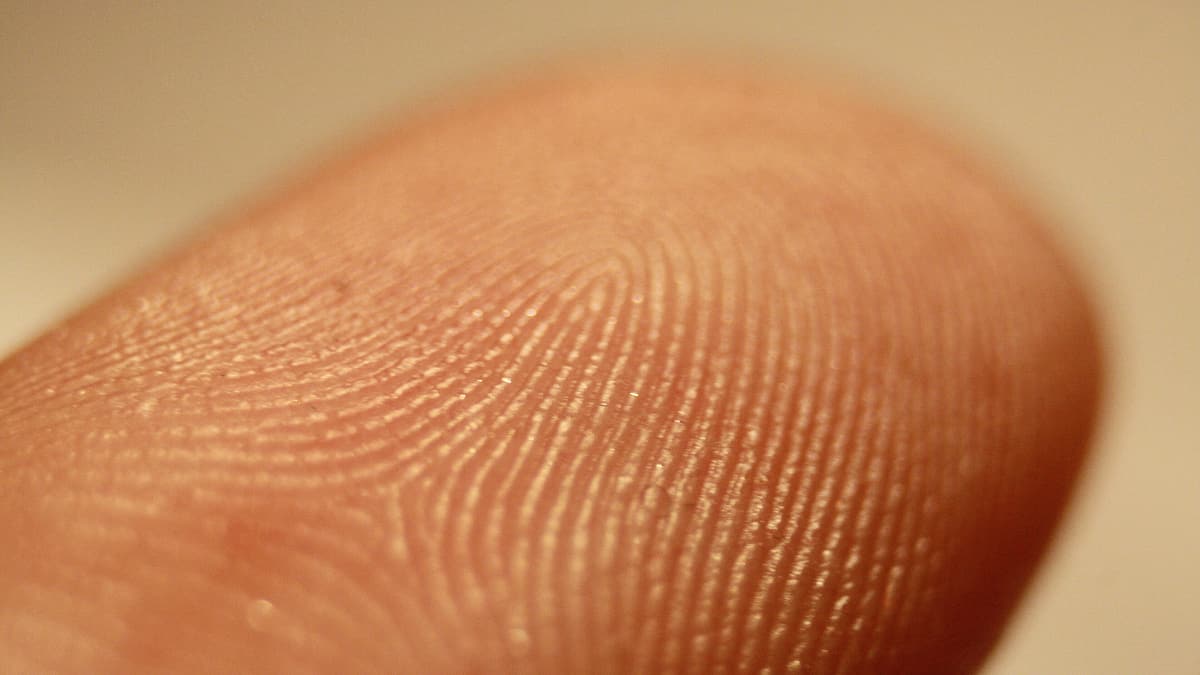
Friction ridge skin on the fingers, palms and soles carries detail conventionally sorted into three levels. Level one is overall pattern and ridge flow: arches, loops and whorls, the general direction the ridges run, the position of deltas and cores. Level one can exclude, because an impression with the wrong pattern cannot have come from a given finger. It cannot identify. Pattern classes are shared by very large numbers of people.
Level two is the path of the individual ridges and the points at which they end or divide — ridge endings, bifurcations, dots and short ridges. These are the features an examiner charts, and most comparisons turn on them. Level three is the fine structure within a ridge: the shape of the ridge edge, the position and shape of pore openings, incipient ridges between the main ones. Level three detail reproduces unreliably and depends heavily on the surface and the development technique.
A latent differs from a recorded exemplar in almost every respect that matters. It is partial, distorted, unevenly deposited on an uncooperative surface, and often superimposed on another impression. An exemplar is taken deliberately under controlled conditions. Comparison is therefore never like for like. The examiner is asking whether observed differences can be explained by distortion and the mechanics of deposition, or whether they mean two different sources.
The four steps and what each involves
Analysis is examination of the questioned impression alone. The examiner assesses clarity, decides which features are reliably present, and reaches a sufficiency determination: whether the impression carries enough information to be compared at all, and if so, what kind of conclusion it could support. That determination is a judgment. No national minimum number of corresponding points governs it, because the discipline moved away from fixed point standards toward a qualitative assessment of quantity and quality together.
Comparison is the feature-by-feature examination of the questioned impression against the exemplar, usually working outward from a small target group of features. Evaluation is the conclusion drawn, together with the reasoning that supports it. Verification is a second examiner repeating the process. Whether verification means anything depends entirely on what the second examiner knows going in, and that varies from laboratory to laboratory rather than by any national rule.
A verification performed by someone who has been told the first examiner identified the impression, and who is handed the charted image with the first examiner's markings on it, tests very little. Blind verification, in which the second examiner receives the material without the first conclusion, is the version that carries weight. The case file should say which was performed and by whom, which is the first record an independently retained examiner will ask to see.
The automated search and the candidate list
Latent impressions are searched against automated fingerprint identification systems that encode features and return a ranked list of candidates. The system identifies no one. It reduces an enormous population to a short list that a human being then examines. A candidate sitting at the top of that list has been ranked by an algorithm on encoded features, and the rank reflects the algorithm's scoring rather than the strength of any comparison performed on it.
Two consequences follow. The first is that the search parameters matter: which database was searched, how the latent was encoded, whether the examiner edited the extracted features, and how many candidates came back. The second is contextual. An examiner who knows a candidate was returned first begins the comparison expecting agreement. A file recording the search and every candidate compared allows that to be checked; a file recording only the candidate that produced a conclusion does not.
In many laboratories the verifier receives the case knowing that the first examiner reached an identification, and works from the same charted image. That arrangement checks transcription and gross error. It does not repeat the examination. Blind and non-blind verification are recorded differently in a procedure manual and should not be described in the same terms in testimony or in a report.
Order of information and the sequencing proposals
Two forms of bias recur in the literature. Contextual bias is the effect of information irrelevant to the comparison — that a suspect confessed, that the offense was violent, that investigators regard the case as solved. Confirmation bias is the tendency to resolve ambiguous features in favor of a conclusion already formed. Neither implies dishonesty. Both operate on judgments made under uncertainty, and a latent comparison consists of very little else.
The structural answer proposed is to control the order in which an examiner receives information. Linear sequential unmasking asks that the analysis of the questioned impression be documented before the exemplar is seen, and that any change made afterward be recorded together with the reason for it. The proposal does not forbid revisiting features. It makes revisions visible instead of invisible, which is the only way a later reader can tell that they happened.
Documentation of analysis before comparison is the operational core of the idea. Where the file contains a marked image of the latent created before the known print was viewed, it is possible to see whether the features relied on were selected independently. Where the only markings were made during comparison, that check is unavailable. Whether a laboratory requires the earlier documentation at all is a matter of its own procedures, examined further in crime laboratory accreditation and audit requirements.
What the studies measured and how conclusions are worded
A black box study measures the accuracy of examiners' conclusions without inquiring into how they were reached. Participants receive impression pairs whose true source is known to the researchers, and their conclusions are scored against it. The National Institute of Justice describes the latent print black box study as reporting a false positive rate of 0.1 percent and a false negative rate of 7.5 percent among the examiners who took part.
What such figures do not supply is an error rate for a particular examiner on a particular impression. They also say nothing on their own about difficulty: the pairs used, the proportion of inconclusive responses, and the way ground truth was established all shape the number. A study of this kind establishes that the discipline can be tested and that error occurs at a measurable rate. It does not calibrate a single comparison.
| Result recorded | What the examiner is asserting | What the file should show behind it |
|---|---|---|
| Identification | The impressions originated from the same source | Analysis documentation, comparison notes, the verification record and its conditions |
| Exclusion | The impressions originated from different sources | The features relied on, and confirmation that the exemplar covered the relevant area of skin |
| Inconclusive | Neither identification nor exclusion is supported | Which of the several inconclusive situations applied under the laboratory's own definitions |
| Unsuitable for comparison | The impression carries too little reliable detail to be compared | The clarity assessment made at analysis, before any exemplar was viewed |
| Candidate list returned | Nothing; an algorithm ranked encoded features | The search request, the database searched, and every candidate returned |
The National Academies report on strengthening forensic science made the broader criticism. Outside nuclear DNA analysis, it found, the pattern disciplines had not been rigorously shown to connect an item to a single source, and they operated without enforceable standards or consistent practices across laboratories. Standards drafting subsequently moved to the Organization of Scientific Area Committees administered by NIST, and NIST's scientific foundation reviews assess the empirical support for individual methods one at a time.
Conclusion language moved with it. Assertions of absolute certainty, of a zero error rate, and of identification to the exclusion of all other people have been withdrawn from federal practice and from many laboratory policies in favor of wording that states a source conclusion and its limits together. The same retreat occurred in firearms and toolmark identification. What a proponent must establish about the method before an examiner testifies at all is treated separately in the reliability showing for a forensic method.
Points to carry away
- Friction ridge detail is sorted into three levels, and only the second and third support a source conclusion.
- Sufficiency at analysis is a qualitative judgment by the examiner and is not governed by a national minimum point count.
- An automated search returns a ranked candidate list, which is a lead for comparison rather than an identification.
- Verification carries weight only to the extent the verifier works without knowing the first examiner's conclusion.
- Linear sequential unmasking asks that the questioned print be documented before the exemplar is seen and that later changes be recorded.
- Claims of absolute certainty and of a zero error rate have been withdrawn in favor of bounded conclusion language.
Questions readers ask
Is there a minimum number of matching points before an examiner may identify a print?
No national minimum governs latent print work in the United States. Fixed point standards were used in some places historically and were abandoned in favor of a qualitative assessment that weighs the quantity of features against their clarity and their rarity. An examiner may reach an identification on relatively few features where the detail is clear and unusual, and may decline on many more where the impression is distorted. Because the threshold is a judgment rather than a count, the reasoning behind it belongs in the case notes and not in the conclusion line alone.
What does an inconclusive conclusion actually mean?
It means the examiner could neither identify nor exclude the source. That single label covers several different situations: a latent with too little clear detail to support any conclusion, corresponding features accompanied by differences the examiner cannot explain, and an exemplar that does not include the area of skin the latent came from. Laboratories differ in how finely they subdivide the category, and some record a separate determination that an impression was unsuitable for comparison at all. The meaning of the word therefore depends on the procedure manual that defines it.
What in a case file allows a comparison to be checked afterward?
The images matter more than the report. A checkable file holds the latent as photographed before and after development, the exemplars used, any markings made during analysis together with a record of when they were made, the automated search request and the candidate list it returned, the comparison notes, and a record of who verified the conclusion and under what conditions. Where the file holds only a conclusion line and a charted image created during comparison, the earlier judgments cannot be reconstructed and the analysis stage survives only as an assertion.
Sources
- National Institute of Justice — The History and Legacy of the Latent Fingerprint Black Box StudyExplains what a black box study measures and reports the false positive and false negative rates the latent print study found.
- National Academies — Strengthening Forensic Science in the United States: A Path ForwardThe finding that the forensic disciplines lack sound policies, national support and enforceable standards.
- NIST — Organization of Scientific Area Committees for Forensic ScienceThe body that drafts discipline-specific standards and maintains the registry laboratories are asked to adopt.
- NIST — Scientific Foundation ReviewsDescribes how a foundation review identifies a method's scientific basis and weighs the empirical evidence for its reliability.
- Federal Rule of Evidence 702 — Testimony by Expert WitnessesRequires the proponent to show reliable principles and methods and a reliable application of them to the facts of the case.
- Federal Rule of Criminal Procedure 16 — Discovery and InspectionCovers results and reports of scientific tests and requires a complete statement of an expert's opinions and their bases.
- 34 U.S.C. § 10562 — Coverdell grant certificationsConditions federal laboratory funding on accreditation and on an independent process for investigating alleged negligence or misconduct.
Premier Defense Law is a publication, not a law firm. This article states general rules and cites its sources; it is not advice about any particular case, and the law differs by state and changes over time.
More in Forensic Evidence

Retaining a Defense Expert and Paying for One
Section 3006A(e) authorizes investigative, expert and other services necessary for adequate representation where the person is financially unable to obtain them. The application may be made ex parte and heard ex parte, so the request does not disclose the theory of the defense. Compensation is capped at an amount the court may exceed on certification approved by the chief judge of the circuit. Rule 706 supplies a court-appointed route, and Rule 16 governs disclosure once the expert testifies.
Firearms and Toolmark Identification
Firearms examination compares class, subclass and individual characteristics on fired components under a comparison microscope. The identification threshold is agreement judged sufficient by the examiner, not a fixed count of matching striae. Subclass carryover from consecutively produced tooling can imitate individual agreement. Correlation databases return ranked candidates, and conclusion wording has moved away from claims of identification to the exclusion of every other firearm.
How a DNA Match Is Expressed and What the Number Means
A short tandem repeat profile is read from an electropherogram, compared against a reference, and reported with a statistic. A random match probability estimates how often the profile would appear among unrelated people, by multiplying allele frequencies across loci under independence assumptions and a subpopulation correction. A likelihood ratio instead compares two stated propositions. Y-chromosome and mitochondrial results are lineage markers estimated by counting.