Testifying or Invoking the Privilege
A witness summoned before a federal grand jury faces a choice that has to be made question by question, in a room without a judge and without counsel, with a lawyer waiting in the corridor and no ruling available until much later.
The rule in short
The privilege against self-incrimination applies in the grand jury room, but it is asserted answer by answer rather than announced at the door. A blanket refusal is generally rejected, because the privilege reaches answers that would tend to incriminate rather than attendance itself. Counsel is excluded from the room, though a witness may leave to consult. A valid refusal is met either by dropping the subject or by a compulsion order backed by immunity.
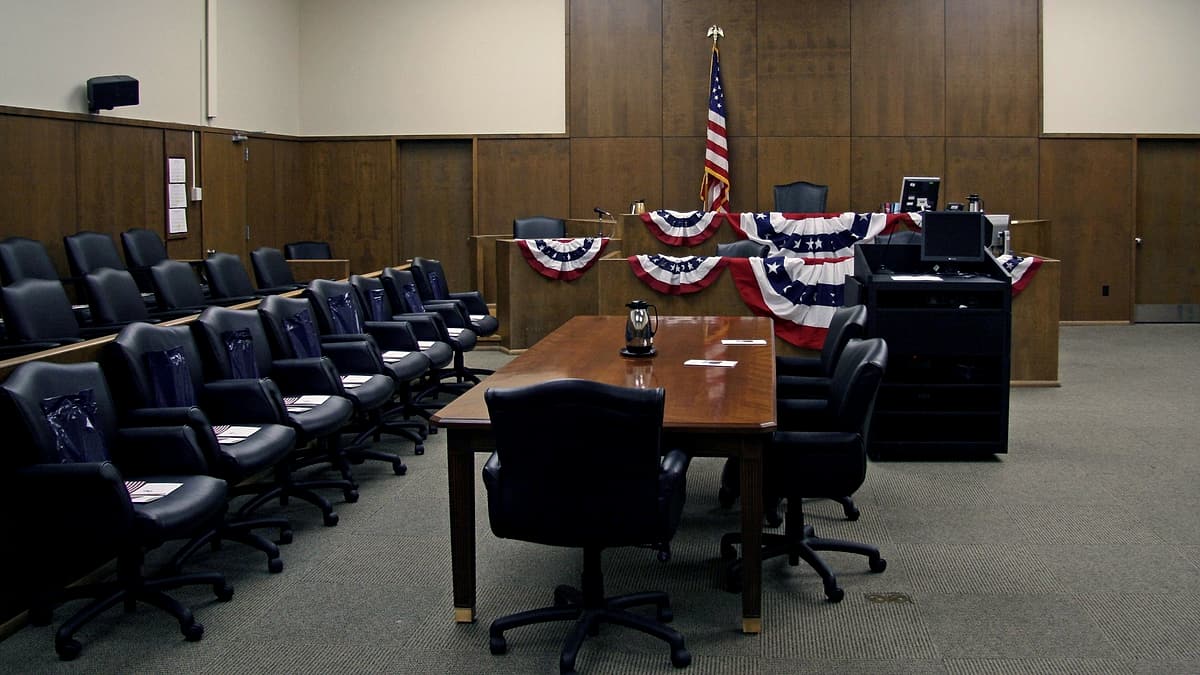
A witness who appears before a federal grand jury walks into a room without a judge, without opposing counsel, and without the lawyer who prepared the appearance. Grand jurors sit in a semicircle. A prosecutor asks the questions. A reporter records everything except deliberations and voting. The decision whether to answer has to be made in that setting, in real time, and it has to be made one question at a time.
How the privilege operates in the room
The Fifth Amendment protects a person from being compelled to be a witness against himself. In the grand jury setting the protection is real but narrow in a particular way: it attaches to answers, not to attendance. A witness must appear, must be sworn, and must answer questions whose truthful answers carry no risk of incrimination. The privilege is available for the remainder.
That structure is why blanket assertions fail. A witness who announces at the outset a refusal to answer anything has given the court nothing to evaluate, because the question whether an answer would tend to incriminate cannot be assessed without knowing the question. Courts confronted with a wholesale refusal ordinarily direct the witness to appear and assert question by question, and only then consider whether particular refusals were justified.
The standard applied is generous to the witness once a specific question exists. The privilege reaches answers that would furnish a link in the chain of evidence, not only answers that would establish guilt outright, and a court may not require the witness to explain the risk in detail without destroying the protection. Where the risk is not apparent from the face of the question and the setting, some further showing may be required, but the threshold is low.
Waiver is the counterweight. A witness who gives a substantive account of a subject may not then decline to supply the detail that makes the account testable, on the reasoning that a half-told story misleads more than silence. Where exactly the line sits is a judgment call, and it moves with how far the initial answer went. That uncertainty is the main reason witnesses step out to consult after individual questions rather than at the end of a topic.
What counsel can and cannot do
Rule 6 lists who may be present during a grand jury session, and retained counsel for a witness is not on the list. The exclusion is settled and is not a matter of local practice. What has developed instead is a corridor practice: counsel waits immediately outside, and the witness may leave the room to consult after any question, returning to answer or to decline.
Courts have treated an unreasonable interference with that consultation as a serious problem, though the remedies available are limited and dismissal of an indictment on that ground is rare. Prosecutors generally accommodate frequent consultation, partly because obstructing it invites litigation and partly because a witness who consults tends to give cleaner answers.
Two consequences follow from the absence of a judge. No objection is ruled on in the room, so a disputed question is answered, refused, or deferred, and the dispute is taken to the supervising court afterward. And the transcript is made without any contemporaneous correction, which means a misunderstanding that would be cleared up in seconds at a deposition sits in the record until someone reads it back.
| Course taken | Immediate effect | Principal risk |
|---|---|---|
| Answer fully | The account is fixed in a sworn transcript | Exposure for any inaccuracy, and waiver as to related detail |
| Assert the privilege question by question | No account is given; the appearance is short | An application for a compulsion order |
| Assert a blanket refusal | Generally rejected as premature | An order to appear and answer, with costs in credibility |
| Testify under a compulsion order | Answers are protected from direct and derivative use | Perjury exposure, and no protection for the acts described |
| Refuse after an order issues | The matter goes to the supervising judge | Coercive confinement for the life of the grand jury |
A witness who decides to answer has taken on an obligation the privilege does nothing to soften. A false material declaration before a grand jury is its own offense, and investigations have concluded with no charge on the original subject and a charge arising entirely from the appearance. Uncertainty is answered by saying so, not by guessing.
What the government does with a refusal
A valid refusal leaves the government three options. It can accept the refusal and move on, which happens more often than witnesses expect. It can seek a compulsion order carrying statutory immunity, which requires internal approval and an application to the district court. Or it can negotiate an informal arrangement with counsel, typically a proffer under which the witness speaks with limited protection.
A compulsion order strips the privilege by removing the risk it guards against. Once the order issues, the witness must answer, and refusal is no longer privileged. Exactly what protection the order supplies, and what it leaves exposed, is set out in immunity and what it actually buys. The short version is that the protection covers the testimony and everything derived from it, and covers nothing else.
Refusal after an order is enforced through the recalcitrant witness statute. Confinement under it is coercive rather than punitive: it ends when the witness agrees to testify, when the grand jury's term ends, or at the statutory ceiling, whichever comes first. Because it is not a punishment, it is imposed without the procedures a criminal sentence would require, and it can be imposed on a witness who has never been charged with anything.
Between those poles sits the informal route. A prosecutor may offer an interview under a written proffer agreement rather than an appearance, on terms that limit how the statements may be used. That route substitutes a contract for a statute, trades a transcript for an agent's notes, and gives counsel a seat in the room. It also involves speaking without the protection the statutory order supplies, and the terms of the letter decide how large that gap is.
Deciding before the return date
The decision is not usually made in the room. It is made in advance, in conversations that reconstruct what the witness actually knows, what documents already say, and what the government appears to be building. A witness whose account is fully corroborated by records the government already holds is in a different position from one whose account is the only proof of a disputed fact.
How the government has described the witness matters to that assessment, which is why the designations discussed in target, subject and witness letters are usually the first thing counsel asks about. So does the state of the documentary record, much of which will have arrived through subpoenas served on banks and other custodians long before the witness was summoned.
One structural point deserves emphasis. Nothing that happens in the room is reviewable while it is happening, and very little of it is reviewable afterward. The transcript is the record, it is made without an adversary, and it will be read years later by people who were not there. That asymmetry, more than any doctrinal rule, explains why the choice is treated as consequential even when the witness has nothing to hide.
Points to carry away
- The privilege must be asserted in response to particular questions, since a court cannot evaluate a refusal in the abstract.
- A witness may leave the grand jury room to consult retained counsel after any question, though counsel may not enter.
- Answering some questions on a subject can waive the privilege as to related detail on the same subject.
- A false answer is a separate federal offense, and the privilege supplies no defense to it.
- The government's answer to a valid refusal is a compulsion order carrying use and derivative use immunity.
- Refusal after such an order is enforced by coercive confinement lasting no longer than the life of the grand jury.
Questions readers ask
Can a witness answer some questions and refuse others?
Yes, and that is the ordinary pattern. The privilege attaches to answers, so a witness may answer background questions and decline others whose truthful answers would furnish a link in the chain of proof. The caution is that answering substantively about a subject can waive the privilege as to related detail on that same subject, on the reasoning that a partial account distorts more than silence does. Where the waiver line sits is a matter of judgment, and the risk of crossing it is the main reason witnesses consult after individual questions rather than at the end.
What happens if a witness lies rather than declining to answer?
A false material declaration before a grand jury is a separate federal offense, prosecutable whether or not the underlying investigation produces anything. The privilege protects a refusal to answer; it does not protect an answer that is untrue. Investigations have ended with no charge on the original subject and a charge for what was said about it. The exposure is the same for a witness who is not otherwise implicated in anything, which is why counsel treats an apparently harmless appearance with the same care as a contested one.
Does a refusal to answer become known outside the grand jury room?
Grand jury proceedings are secret and the participants other than the witness are bound not to disclose matters occurring before the grand jury. The witness is not bound and may speak about the appearance. In practice the fact of an invocation reaches an employer, a regulator or a counterparty often enough that it should be assumed capable of emerging. In a subsequent civil proceeding an adverse inference may be drawn from a refusal to answer, a consequence that does not apply in a criminal trial.
Sources
- Federal Rule of Criminal Procedure 6 — The Grand JuryLists who may be present while the grand jury is in session and requires that proceedings be recorded.
- 18 U.S.C. § 6002 — Immunity generallySupplies the use and derivative use immunity that overrides a valid assertion of the privilege.
- 18 U.S.C. § 6003 — Court and grand jury proceedingsSets the procedure for the government's application for an order compelling testimony.
- 28 U.S.C. § 1826 — Recalcitrant witnessesAuthorizes coercive confinement of a witness who refuses to testify after being ordered to do so.
- Justice Manual, Title 9-11.000 — Grand JuryStates Department policy on advising witnesses of their rights and on subpoenaing a target to testify.
- Federal Rule of Criminal Procedure 17 — SubpoenaProvides the compulsory process that brings a witness to the room in the first place.
Premier Defense Law is a publication, not a law firm. This article states general rules and cites its sources; it is not advice about any particular case, and the law differs by state and changes over time.
More in Grand Jury & Charging
The Act of Production and Its Own Privilege
A subpoena for documents can raise a Fifth Amendment problem even when nothing written in the documents is protected. Producing items implicitly asserts that they exist, that they are in the producer's control, and that they answer the description used. Where those assertions are incriminating and not already known, the act is testimonial. The foregone conclusion doctrine removes the protection where the government can independently establish what the production would concede.
The Indictment and the Elements It Must Allege
An indictment must be a plain, concise and definite written statement of the essential facts constituting the offense charged, signed by an attorney for the government and citing the provision alleged to have been violated. It gives the defendant notice sufficient to prepare a defense and allows a later plea of double jeopardy. A charge omitting an element is defective. Because only a grand jury may alter what it charged, proof that broadens the charge presents a constructive amendment problem.
The Subpoena and the Return Date It Sets
A federal grand jury subpoena issues under Rule 17 in the name of the court, signed in blank by the clerk and completed by the government. It may command testimony, the production of designated material, or both. The return date fixes when the obligation matures and starts the practical clock for any objection. Nonappearance and refusal to produce are addressed through the court's contempt power and through civil confinement for a recalcitrant witness.